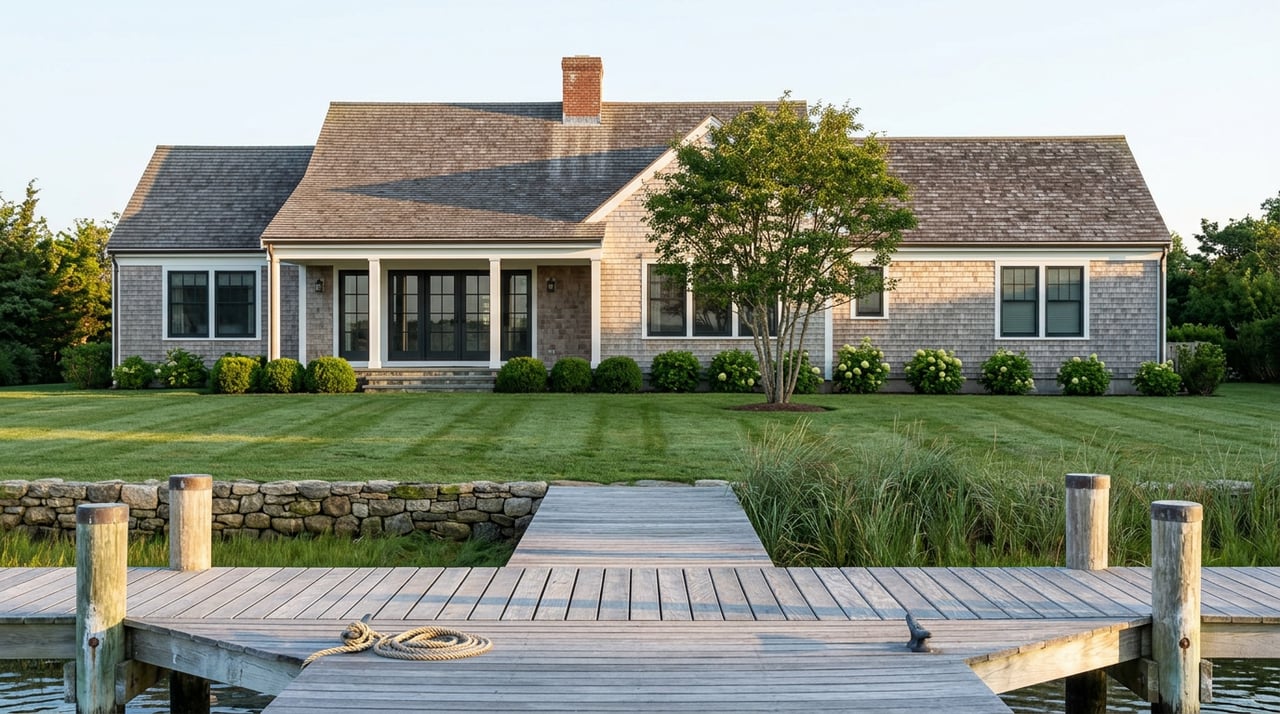
Two listings can carry the word "waterfront" in Southport this season, sit within the same few hundred thousand dollars of each other, and hand their new owners entirely different relationships with Long Island Sound. One comes with a private dock steps from the back lawn. The other comes with a name on a waiting list and a membership application. Nothing in the listing photos tells you which is which, and the asking price rarely sorts it out either.
That gap is the thing worth understanding before anyone writes an offer on water in Southport. "Waterfront" isn't a single product here. It's at least four different arrangements, stacked on top of a harbor channel that spent the better part of two decades quietly shrinking, and only got fixed a year and a half ago.
The Channel That Was Too Narrow For Twenty Years
Southport Harbor last saw a full Army Corps of Engineers maintenance dredge between 2004 and 2005. After that, sediment kept building. By the fall of 2024, the Town's Harbor Management Commission and Harbor Master Bryan LeClerc measured the channel at roughly 52 feet wide at low tide, a bottleneck that restricted multiple boats from entering or exiting at once and created a current strong enough that vessels were reported taking evasive action to avoid collisions.
The Town had wanted a fix for years. Federal funding didn't come through until 2022, and even then the project waited in line behind other harbors competing for the same Army Corps dredge vessel. Work finally began in mid-January 2025, when a 156-foot dredging ship called the Murden arrived and crews worked around the clock for about four weeks, funded by roughly $1.2 million in federal money. By the end of that month, the Army Corps had restored the channel to a nine-foot depth and a 100-foot width at low tide, and the dredged sand was relocated to a nearshore placement site off Southport Beach, where it's expected to settle into an oyster and clam bed over time.
Here's why that matters to a buyer looking at listings today. For roughly twenty years, a property's "waterfront" status didn't fully describe what a boat owner could actually do with it. A dock or mooring that looked fine on paper sat behind a channel that was quietly narrowing every season. The fix is recent enough that anyone evaluating a Southport waterfront property should ask when the seller's dock or mooring tackle was last inspected, because the water conditions underneath that asset changed materially within the last two years.
What the Deed Actually Grants You
In Connecticut, a waterfront owner's rights extend to the mean high water line. Below that, the state holds the submerged land in public trust, meaning the general public retains rights to fish, boat, and pass along the shore even in front of a private residence. Owning waterfront land gives you a right of reasonable access to the water, commonly exercised through a mooring or a dock, but it does not automatically authorize you to build one. Docks require permitting, and the rules get stricter when a property's access runs through an easement rather than direct frontage: an easement doesn't create new littoral rights, so a dock built on one is generally not permittable the way a dock on true frontage is.
That distinction sounds technical until you're standing in front of two Southport listings that both use the word "waterfront" in the first sentence. One might have 200 feet of direct Sound frontage and a documented right to a private dock. The other might offer a path to the water across land someone else owns, with no dock rights attached at all. Both are accurately described as waterfront. Only one lets you put a boat in without asking permission.
Four Ways a Southport Listing Actually Delivers Water
| Tier | What it grants | Where you'll find it |
|---|---|---|
| Deeded frontage with private dock | Direct water access and the recorded right to build or maintain a dock | Sasco Hill Road and Rock Point Road estates with direct Sound frontage |
| Mooring inside the Pequot Yacht Club field | A managed mooring under the Club's Memorandum of Agreement with the Town, tied to membership | Properties near Harbor Road within the Club's mooring area |
| Town mooring waitlist | A permitted mooring in the Harbor Master's North Anchorage, allocated through the Town's online waitlist | Any Southport Harbor property without a private dock or Club membership |
| Beach association or resident sticker only | Seasonal access to sand and swimming, no boat rights implied | Sasco Beach and Southport Beach, both resident-sticker beaches bordering association-held land |
The fourth tier catches the most people off guard. A house within walking distance of Sasco Beach or Southport Beach is genuinely close to the water, and that proximity carries real value. But a beach sticker is not a boat right, and the beach itself may sit next to land held by a private association rather than the Town outright. Southport Beach, for example, borders land owned by the Sasquanag Association for Southport Improvements, a private group named directly in the Town's own beach ordinance. Knowing which entity actually controls the sand next to a property, and whether that entity's rules run with the deed or with the season, changes what "close to the water" is worth.
The second and third tiers get confused just as often. Pequot Yacht Club, founded in 1920 and based on Harbor Road in the historic district, manages its own mooring field under a formal agreement with the Town, separate from the Harbor Master's own North Anchorage upstream. A property being near the harbor doesn't tell you which system a mooring would fall under, and the Club's guest moorings are limited and offered first come, first served, which is a different scarcity model than the Town's managed waitlist through its online mooring system.
Why Southport's Median Price Depends on Which Southport You Mean
Ask three different sources for Southport's median home price this year and you'll get three different answers, and the gap isn't noise. Public data compiled through RPR put Southport's median sale price at roughly $1.34 million as of July 2026. Other listing platforms tracking the same period showed medians swinging from around $650,000 to well over $1.7 million within a matter of months.
That spread exists because "Southport" describes two overlapping but different markets. One is the compact harbor village: Federal and Colonial homes clustered around Harbor Road, the train station, and the historic district, many of them walking distance to Pequot Yacht Club and the water. The other is a wider surrounding area that shows up under the same name in broader searches, including condominiums, inland streets, and homes with no water relationship at all. A search radius produces one number. A walk down Harbor Road produces a different one.
It's the same lesson as the water rights question, applied to the whole neighborhood name instead of a single listing. A single label can describe products that don't actually compete with each other on price, which means the median a reader sees is often answering a different question than the one they meant to ask.
Questions Worth Asking Before You Assume
- Is the dock deeded specifically to this parcel, or does access run through an easement that may not carry dock rights with it?
- If a mooring is included, is it part of the Pequot Yacht Club's managed field, or does it depend on the Town's separate waitlist through the Harbor Master's office?
- Does beach access come from a recorded deed right, or from a resident sticker or association membership that belongs to the town or the association, not the house?
- When was the dock or mooring tackle last inspected, given how much the harbor's channel condition changed between the 2004-2005 dredge and the 2025 fix?
A Few Distinct Questions
Does owning waterfront property in Southport automatically come with a dock? No. Connecticut law gives waterfront owners a right of reasonable water access, typically exercised through a dock or mooring, but the structure itself still requires permitting, and rights built on an easement rather than direct frontage are treated differently.
How do I find out whether a mooring is in the Pequot Yacht Club's field or the Town's system? The Club's Marine Department manages its own field under its agreement with the Town, while the Town's Harbor Master's office runs a separate permit system and public waitlist for its own anchorage. A seller or their agent should be able to identify which system a given mooring falls under.
Are Sasco Beach and Southport Beach the same kind of access? Both are resident-sticker beaches rather than open public beaches during the summer season, and Southport Beach sits next to land held by a private association rather than the Town. Neither grants any right to a dock or mooring simply through proximity.
Understanding which of these four products a listing is actually offering, and confirming it before an offer goes in rather than after, is exactly the kind of groundwork a buyer shouldn't have to do alone. If you're comparing water access across Southport listings and want someone who can tell you which tier you're actually looking at, On The Harbor is ready to help you request a private home valuation and walk the harbor with you before you decide.
