A well-priced listing in Newtown this year rarely sees one offer. It sees three to five. That is the shape of competition across the town right now, and it describes a market that sounds uniformly hot.
But two buyers who just lived through that exact bidding war may have been shopping in what amount to two different economies. One was likely fighting for a smaller Cape or ranch near Sandy Hook, the kind of entry-level home that has been trading in the $450,000 to $550,000 range. The other may have been chasing a colonial or modern farmhouse pushing past $900,000, on a very different clock, with very different lenders involved. Newtown does not have one housing market. It has at least three, and the town just made a policy decision that proves it.
Three Price Tiers, One Town
The number most buyers see first is the town-wide median, which has sat somewhere between $650,000 and $755,000 through the first half of 2026 depending on the month measured. That figure is real, but it is an average of homes that rarely compete with each other for the same buyer.
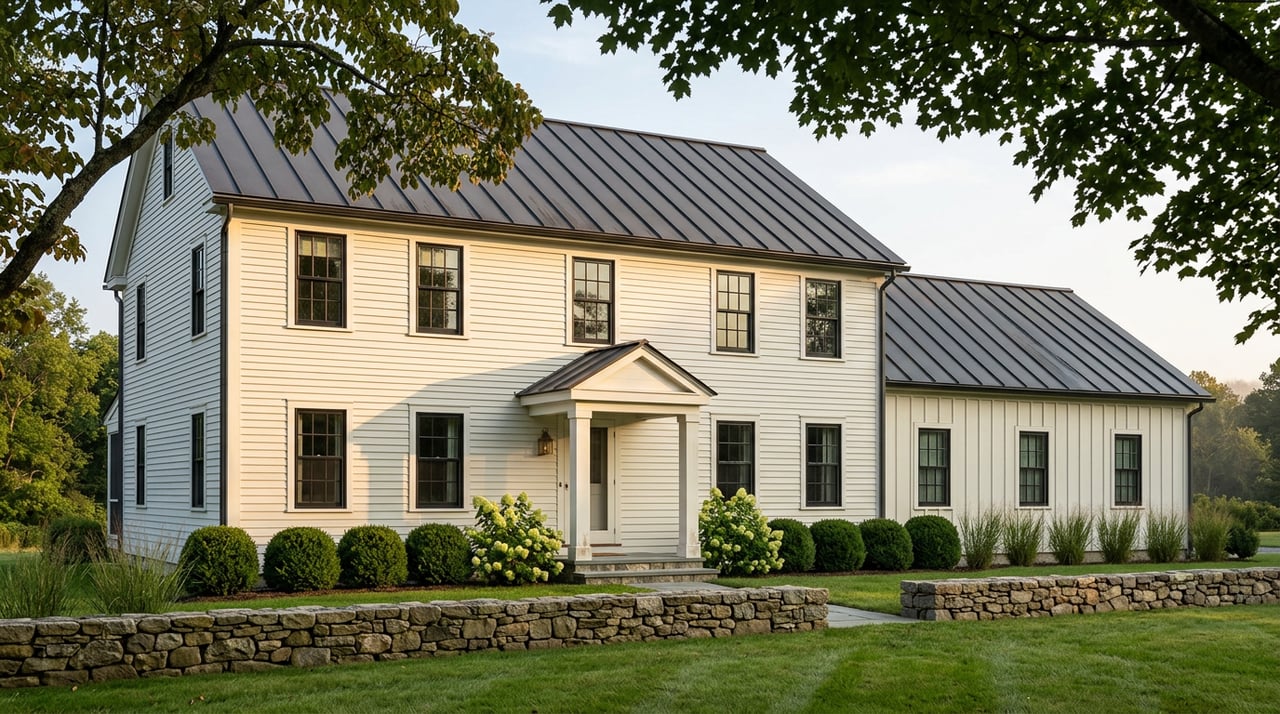
At the entry level, smaller Capes and older ranch-style homes concentrated around Sandy Hook have been the most attainable inventory in town, typically listed in the $450,000 to $550,000 band. At the top, larger colonials, modern farmhouses, and equestrian properties list regularly between $900,000 and $1.5 million, with true estate-scale properties pushing well beyond that ceiling. In between sits the broad middle that produces the headline median.
| Tier | Typical range | What sets the pace |
|---|---|---|
| Entry (Sandy Hook capes and ranches) | $450,000–$550,000 | Fastest-moving, often pending within two weeks |
| Middle (colonials, standard single-family) | $650,000–$755,000 | Sets the town-wide median most buyers see |
| Upper (farmhouses, equestrian, true estates) | $900,000–$1.5 million and up | 90 to 120 days on market, jumbo financing |
A buyer comparing Newtown's median to a neighboring town's median is comparing two blended averages without knowing what went into either blend.
The Averages Are Arguing With Each Other
Here is a detail that should give any comparison-shopper pause. One data source tracking May 2026 activity put Newtown's average time on market at 55 days, with roughly two months of supply on hand. A separate source tracking June 2026 put average time on market at 31 days, a swing of nearly four weeks in a single month. Both also noted fewer homes changing hands than a year earlier.
That is not a data error. It is what happens when a town-wide average is built from an unstable mix of three markets that move at different speeds. If a given month's closed sales happen to include more Sandy Hook starter homes, the average days-on-market number drops fast, because those homes are pending in under two weeks. If the mix skews toward the equestrian and estate tier, where 90 to 120 days is normal because jumbo loan underwriting takes longer and buyers are more selective, the average stretches out just as fast. The town-wide number is not lying. It is just measuring a moving target, which is exactly why it is a poor tool for comparing Newtown to somewhere else.
The one constant across every data source is the lock-in effect. Homeowners who secured mortgage rates in the 2 to 3 percent range during the pandemic years have little financial incentive to sell into today's 6-plus percent environment, and that reluctance is what keeps inventory tight enough to sustain multiple-offer situations even as overall transaction counts slip year over year.
The Town Just Voted to Prove the Point
On June 17, 2026, Newtown's Legislative Council unanimously approved a lease agreement with Winn Development Company to renovate Shelton House, one of two historic former state hospital buildings on the Fairfield Hills campus, as detailed by The Newtown Bee. The vote followed unanimous recommendations from the Fairfield Hills Authority in April and the Board of Selectmen in May, and it clears the way for Winn to begin structural and environmental inspections before a final purchase agreement.
The plan for Shelton House calls for age-restricted, moderate-income apartments with a modest ground-floor commercial component, limited by the building's layout to one or two thousand square feet. Kent House, the larger of the two buildings, is expected to follow with a lease of its own once Shelton's condition is further along, and current plans call for roughly 125 predominantly age-restricted, moderate-income units alongside up to 5,000 square feet of ground-floor commercial space, protected by historic preservation rules that limit changes to the exterior.
This matters to anyone trying to read Newtown's market from a single number, because it is direct evidence that the town itself treats its housing stock as separate, non-competing tiers. New supply is being routed deliberately into an age-restricted, moderate-income category, which means it will not show up as relief in the Sandy Hook entry tier or the equestrian estate tier a move-up buyer might be watching. Not every council member was comfortable with the sequencing. Councilman Chris Eide raised concerns that the town was, in his words, "backing into this," worried about placing higher-density housing between a school and a nearby correctional facility. The concern was about location and process, not about whether the project would compete with market-rate inventory elsewhere in town. It will not.
The Acres Have Their Own Rules
The upper tier has a mechanism entirely its own, and it rarely appears in a market report built from portal averages. The corridor around Huntingtown Road holds some of the largest contiguous residential acreage left in Fairfield County, and properties there with five or more acres, barns, and paddocks frequently transact above $2 million.
What a buyer in that tier can do that a Sandy Hook buyer cannot is apply for Newtown's agricultural property tax exemption, codified in the town's own ordinance under Chapter 208, Article IX. To qualify, an owner must file a notarized affidavit with the assessor by November 1 of each year certifying that the property generated at least $15,000 in gross farming income, or incurred at least $15,000 in farming-related expenses, in the prior tax year. Connecticut's Department of Agriculture outlines the broader framework for these agricultural exemptions and abatements on its state portal. For a buyer willing to maintain even modest hay production, boarding, or forestry activity, this exemption can meaningfully lower the effective carrying cost of a large parcel that would otherwise carry one of the highest tax bills in town. It is a real number in a real ledger, and it explains why the math on a $2 million Huntingtown Road estate looks different from the math on a $2 million property without qualifying acreage.
What This Means If You Are Comparing Towns
A buyer who came to Newtown after watching a single median price line on a chart is not wrong to be interested. They are just working with the wrong unit of comparison. The real question is not "what does Newtown cost" but "which of Newtown's markets are you actually shopping." A Sandy Hook Cape, a Borough colonial near the flagpole, and a Huntingtown Road estate are not three points on the same curve. They are three different products with three different buyer pools, three different financing paths, and now, with the Fairfield Hills vote, a fourth category of housing supply that was built specifically not to touch any of them.
Does the Fairfield Hills housing project affect nearby home values? The Shelton House and Kent House units are age-restricted and moderate-income by design, a separate housing category from the market-rate single-family homes that make up the bulk of Newtown's sales activity, so it functions as new supply in its own lane rather than competition for existing single-family inventory.
Why do upper-tier homes sit longer without signaling weakness? Jumbo loan underwriting takes longer than conventional financing, and buyers at that price point tend to be more selective and more likely to have a contingent sale of their own home, both of which stretch the 90 to 120 day average without indicating soft demand.
Comparing towns off a single median is how a lot of buyers end up frustrated three weeks into a search, wondering why the house they can afford does not look like the one on the listing photo they saved. On The Harbor, led by Libby McKinney Tritschler, works from the tier level, not the town-wide average, because that is the level where an offer actually gets written and won. If you are trying to figure out which of Newtown's markets fits your search, or what a comparable property in Southport, Westport, or Fairfield would cost you by comparison, request a private home valuation and we will walk through the real numbers together.
This article is general information, not legal, tax or financial advice. Consult a qualified professional about your situation.
